
Shenandoah National Park
This piece was unveiled April 30th, 2026 in the United States, and will be displayed in the United Kingdom
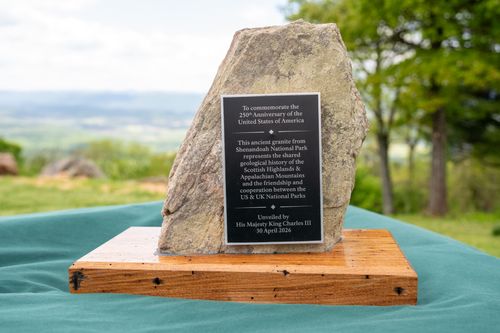
A Commemorative Granite Piece Representing the United States in an International National Park Exchange
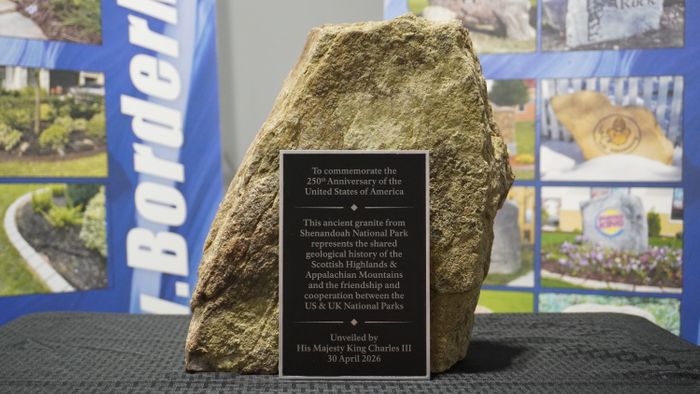
Created for the 250th Anniversary of the United States, an exchange between the US & UK National Parks was unveiled by King Charles III on April 30th, 2026. This commemorative piece will travel back to the United Kingdom with King Charles III after the exchange.
Angelopulos StoneCraft was entrusted to design and complete a commemorative granite piece representing the United States in this one-for-one exchange. Each country was tasked with creating a permanent piece to represent its history, material, and message abroad.
The intent of the US piece was to work with natural, raw granite rather than milled stone to preserve authenticity while creating a form capable of carrying a precise and lasting inscription. Working alongside National Park leadership, the project required balancing the character of the stone with the technical demands of executing the text clearly and permanently.
Articles
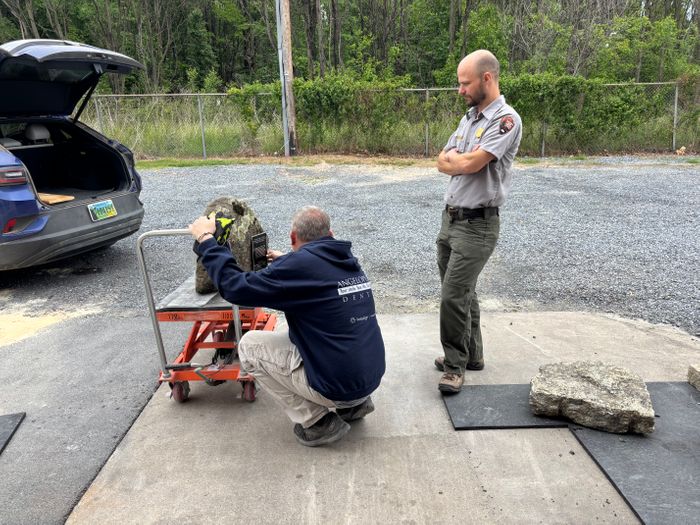
The Challenge
The project presented a set of constraints that made a standard approach insufficient:
- The goal was to preserve the natural character of raw granite while incorporating a detailed inscription that needed to remain clear, legible, and permanent.
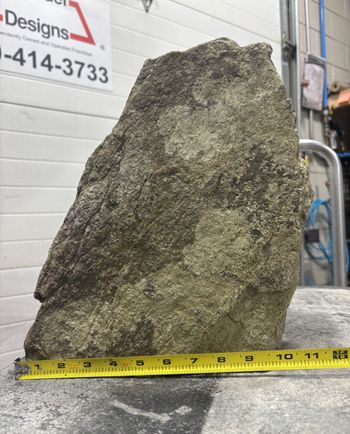
- The usable surface area was limited; approximately 9 inches by 13 inches and further reduced by natural variations in the stone’s face.
- The stone could not be treated like a typical engraving surface.
- Required rapid coordination and execution within a compressed timeframe, including full-scale prototyping and final fabrication completion
Unlike milled stone, the irregular surface of raw granite introduced:
- Inconsistent depth and texture
- Variation in color across the face
- Areas of structural concern, including existing cracks
Each of these factors impacted how and where the inscription could be executed.
Multiple alternative stones and execution approaches were evaluated. Each introduced its own limitations such as the surface quality, size, or authenticity of origin. At the same time, the piece needed to meet a higher level of presentation, given its role as a permanent, internationally displayed commemorative object.
We wanted to maintain the authenticity of the material while still achieving precision in the message.
A conventional approach would have compromised either the material or the message, but neither of these was acceptable for a piece of this significance.
The Constraint
A direct sandblasted inscription was initially considered, but based on the material conditions, it was ruled out. Alternative methods including laser engraving and diamond cutting were also evaluated. Each required a level of surface consistency and control that the natural granite did not provide.
The irregular surface of the raw stone would not allow for consistent depth or edge definition across the lettering. Variations in color across the face would further reduce contrast and readability once the text was applied. Those limitations combined with the limited usable surface area and existing structural imperfections would have made the result uneven, difficult to read, and visually inconsistent.
Proceeding with any of these methods would have compromised the clarity and integrity of the piece. A different approach was required.
Our Role
Early in the process, it became clear that achieving both authenticity and clarity would require deliberate decisions, not default methods. Multiple alternative stones and execution approaches were explored, however each introduced tradeoffs, whether in surface consistency, scale, or authenticity of origin.
At several points, the easier path would have been to replace the original granite with a more uniform material or reduce the demands of the inscription, but as we've stated previously, that approach was deliberately avoided. Maintaining the integrity of the original Shenandoah granite remained central to the project. Its origin and natural character were not interchangeable, even when it introduced additional complexity. This required working within the limitations of the material rather than selecting a more convenient alternative.
From there, the focus shifted to developing a solution that could deliver precision without compromising the stone. We refined the inscription for clarity and structure, guided layout decisions based on the limited usable surface, and evaluated multiple execution methods before determining that direct engraving would not produce an acceptable result.
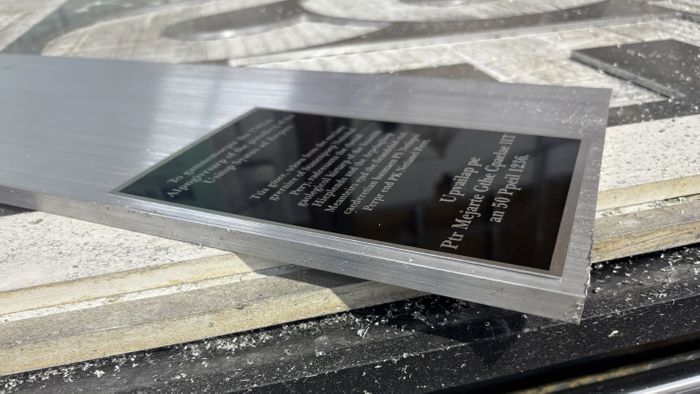
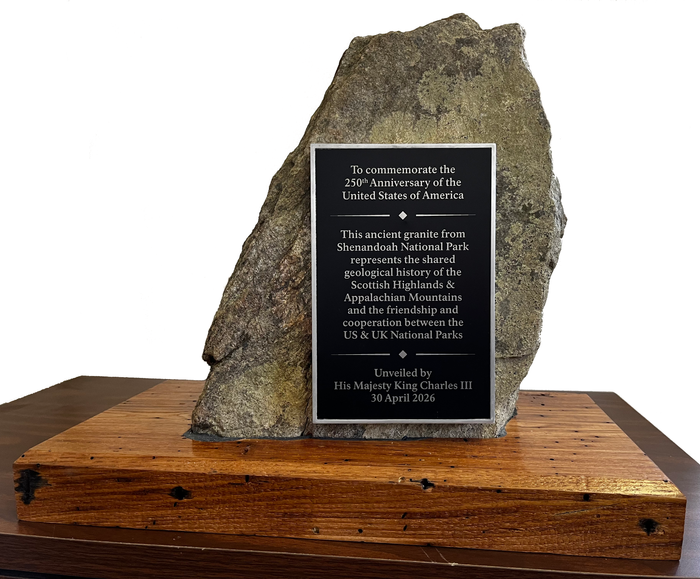
Once the plaque-based solution was established, we coordinated rapid prototyping and fabrication to meet project timelines. We worked with a fabrication partner Muddy Feet Graphics of Rockingham, VA to produce and refine a full-scale proof followed by their final execution of the plaque within 24 hours. Additionally, due to structural instability in the stone, we identified the need for a supporting base. A wormy chestnut base was developed to stabilize the piece and complete its appearance.
Throughout the process, decisions were made with a single priority: Protecting the integrity of the piece while ensuring it could be executed correctly.
The Solution
The final solution was developed to resolve the limitations of the material without compromising the integrity of the piece.
- A custom-designed engraved plaque was integrated with the natural granite, allowing the inscription to be executed with precision, clarity, and long-term durability.
- To address structural instability in the stone, a base system was incorporated to properly support and present the piece.
The result was a composition that preserved the authenticity of the granite while achieving the level of precision required for a national commemorative piece.
The Result
The completed piece features a natural granite boulder sourced from Shenandoah National Park, paired with a precisely executed engraved plaque and supported by a handcrafted wormy chestnut base.
Each element serves the specific purpose of preserving the authenticity of the material while ensuring the message is delivered with clarity and permanence.
The piece was unveiled April 30, 2026, by King Charles III as part of an international exchange between US & UK National Parks and will be permanently displayed in the United Kingdom within a controlled setting.
Created as the United States’ contribution to this exchange, the piece represents the friendship and cooperation between the US & UK National Parks as a deliberate balance between natural form and precise execution, ensuring it can be both experienced visually and understood clearly over time.
Applying This Approach Locally
Projects like this carry a level of responsibility where the outcome cannot be left to chance. Every decision, material, layout, execution, has lasting consequences.
That same approach applies to the work we take on locally. Whether it’s a business entrance, a community installation, or a property feature meant to represent families over time, the process is the same:
- Listen to the clients
- Customize their design
- Make the right decisions early
- Execute it properly
Because when something is intended to be permanent, it has to be done right.
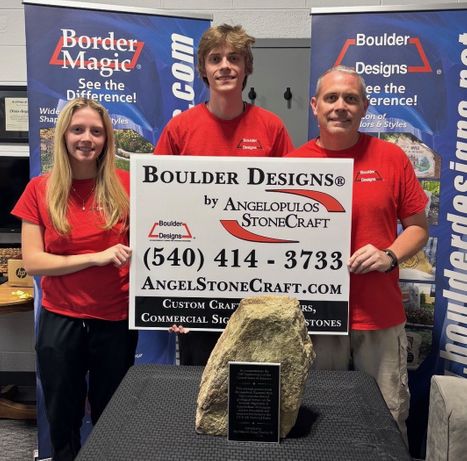
Angelopulos StoneCraft is led by Dr. Chris Angelopulos, who spent 25 years in a profession where precision and trust were required on every patient. That standard carries through to the work we do today.
If you’re considering a project where the result needs to be done right, we’re available to talk through ideas and determine the right approach.